
For 99% of organisations, the obstacle to adopting AI is trust. That is my read, and I will own it. The technology cleared the bar for most small and mid-sized business work some time ago. What has lagged behind is the confidence to hand any of that work over.
The technology stopped being the problem
The work most Australian SMBs need help with is unglamorous. Drafting client emails. Chasing documents. Summarising a 40-page contract. First-pass analysis of last quarter’s numbers. Today’s AI assistants do all of it competently for around $30 to $50 a month per person, running inside the Microsoft or Google tools most businesses already pay for.
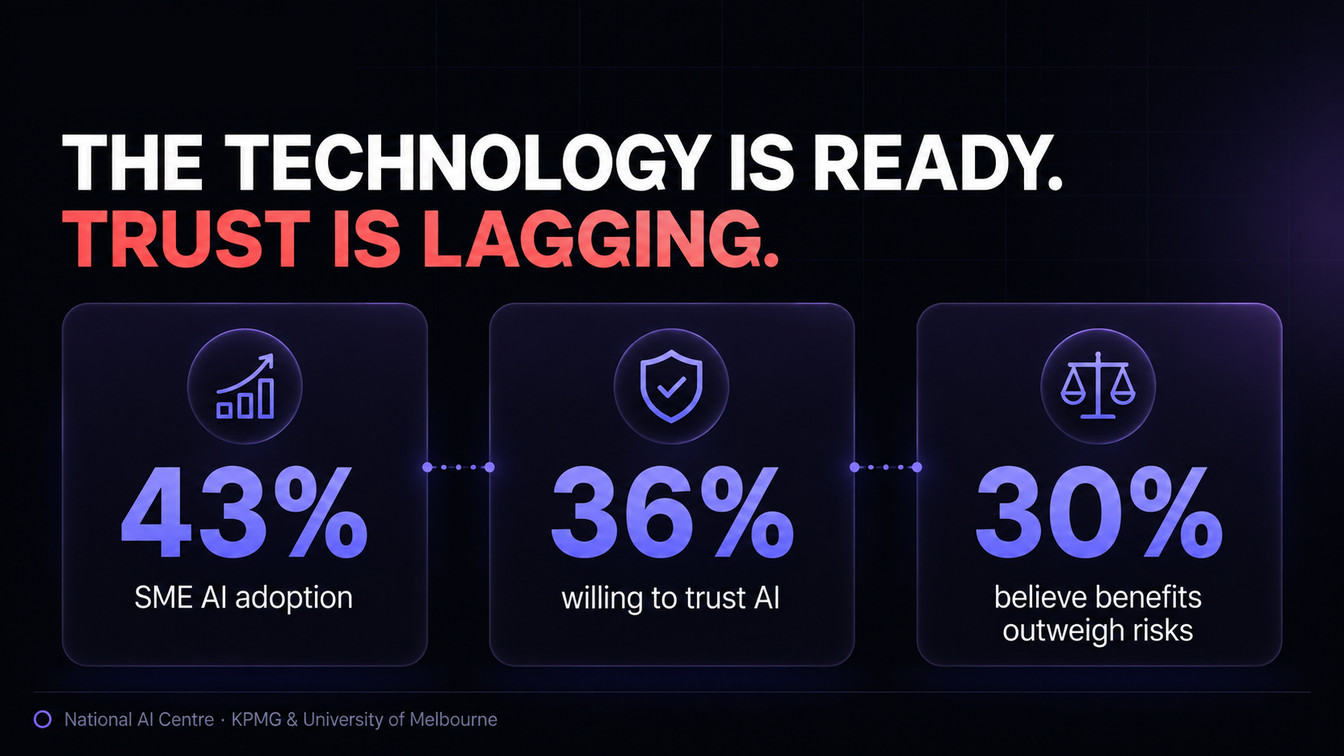
Yet fewer than half of Australian SMEs use AI at all. In the December 2025 to February 2026 quarter, the National AI Centre’s AI Adoption Tracker put SME adoption at 43%.
The reason the rest give for staying out is the interesting part. Around 65% of non-adopting businesses cited either distrust of AI decision-making or a strong preference to keep human control of their processes. The National AI Centre’s own conclusion: adoption “can’t be reduced to capability or cost alone - it is fundamentally a question of confidence.”
We are also unusually wary by world standards. The KPMG and University of Melbourne global study of over 48,000 people across 47 countries found only 36% of Australians willing to trust AI, and just 30% who believe its benefits outweigh its risks. That was the lowest share of any country surveyed.
Your customers are further along than you think
The fear I hear most often from business owners is about the people they serve: if clients find out we use AI, will it damage the relationship?
The best data I have seen on this question is Karbon’s July 2026 report, The Future of Client Trust in the Age of AI, which surveyed 350 US small business owners about the professional relationship most dependent on trust: the one with their accountant. Trust was the top reason clients chose their firm, at 39%. Technology ranked last, at 12%.
Those trust-driven clients turned out to be relaxed about AI. Only 2% were uncomfortable with AI involvement in their work at all. 89% wanted openness about where AI is used. 54% would pay more for AI-enabled capability they had never had before, such as real-time dashboards and cash flow forecasts. And 81% said their accountant becomes more valuable if AI handles 90% of the routine work and the saved hours fund a monthly strategy call.
Clients drew one firm line: humans stay in charge of the moments that matter. 61% wanted the trusted advisor role led by a person, and 58% said the same about crisis management.
It is a US survey, and client attitudes here will not map across perfectly. But the pattern matches what I hear in assessment sessions with Australian firms, where the first question is rarely about capability. It is about exposure: who sees our client data, and what happens if AI gets something wrong in front of a customer.
The uncomfortable finding sits on the firm side. Clients want disclosure, yet Karbon’s earlier research found only 21% of firms have a documented AI policy. The National AI Centre sees the same gap in Australia: businesses using AI mostly check outputs internally, while transparency with customers “lags significantly”. Customers are asking a question most businesses have not yet written down an answer to.
Trust is built the way you build it with people
You would not hire a graduate on Monday and hand them your top client on Tuesday. You would give them something small and low-stakes, check the work, and extend the brief as they earned it. AI adoption works the same way.
That idea sits at the centre of The AI-Powered Business, the guide I wrote introducing the AI Workforce Maturity Model™. The model describes ten levels of AI maturity, and each level measures one thing: how much meaningful work your organisation is prepared to trust AI to perform. Answering questions comes early. Drafting comes next. Taking action inside your systems, then owning whole processes and roles, comes later, each step a bigger delegation than the last.
Two sections of the guide speak directly to breaking the trust deadlock:
- The AI Pilot Lane (Part Three) is the mechanism for earning trust without betting the business. Leave your existing process untouched. Run an AI-enabled version alongside it, with one person or a small team responsible. Compare quality, time, cost and risk. When the AI-enabled version consistently wins, it becomes the standard. Nothing is trusted before it is proven.
- Your First 90 Days (Part Four) turns that into a plan: 30 days understanding where the time actually goes, 30 days running your first pilot, 30 days building on what you learned.
And borrowing the clearest recommendation in the Karbon report: write your AI policy before a customer asks. One page covering where you use AI, where you never will, who checks the work, and how a customer can raise a concern. The 89% who want transparency are simply asking you to be able to answer the question.
Where to start
If AI adoption has stalled in your organisation, stop evaluating tools. Pick the one process that consumes the most time for the least value, and run an AI Pilot Lane against it for 90 days. Measure it honestly. Trust the result, whichever way it lands.
The full framework, including the ten maturity levels and the 90-day plan, is in The AI-Powered Business guide. Download it here.
References
- National AI Centre, AI adoption insights: December 2025 to February 2026, published 7 May 2026.
- Gillespie, N., Lockey, S. et al., University of Melbourne and KPMG, Trust, attitudes and use of artificial intelligence: a global study 2025, April 2025.
- Karbon, The Future of Client Trust in the Age of AI, July 2026.
- Quigly AI, The AI-Powered Business: the AI Workforce Maturity Model, 2026.
Find out where your business actually sits.
An AI Strategy and Roadmap maps your specific situation against the ten levels.
Get Context Matters by email
One practical AI idea for Australian business owners, every second Wednesday. No hype.